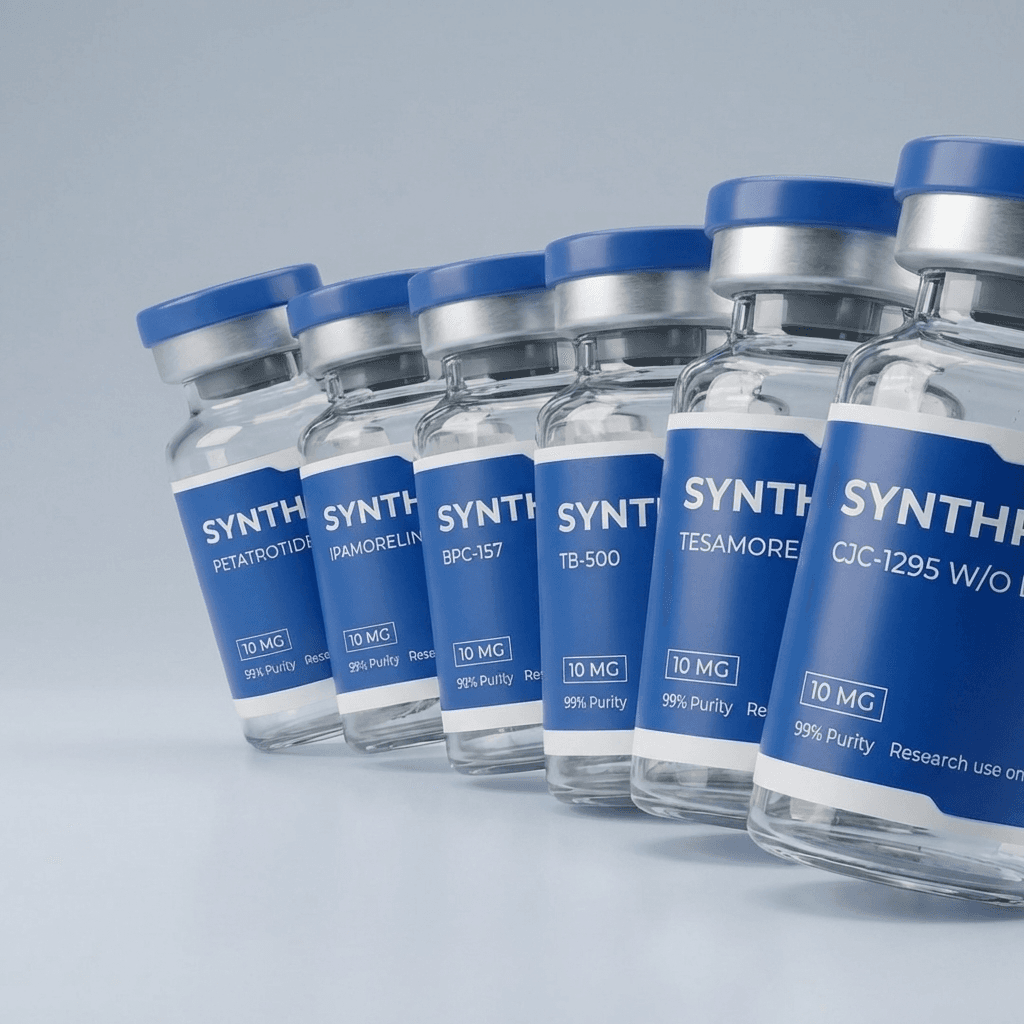

Direct answer: Retatrutide is a single peptide molecule that simultaneously activates three receptors: GLP-1, GIP, and glucagon. This "triple agonist" mechanism is what separates it from semaglutide (GLP-1 only) and tirzepatide (GLP-1 + GIP). The added glucagon receptor activation increases resting energy expenditure and hepatic fat oxidation — which is why retatrutide produces 4–8% more weight loss than tirzepatide at comparable doses despite a similar GI side effect profile.
Key Takeaways
- Three receptors, one molecule. Retatrutide (LY3437943) is a single peptide with three receptor-binding regions, not a cocktail of three drugs.
- GLP-1 agonism drives appetite suppression and improved insulin secretion.
- GIP agonism complements GLP-1 by enhancing insulin sensitivity and improving lipid metabolism.
- Glucagon agonism — the third and unique receptor — raises energy expenditure and accelerates hepatic fat oxidation.
- The structure is a 39-amino-acid peptide with a fatty acid side chain enabling albumin binding for a 6-day half-life.
- "GLP-3" is an informal nickname some users apply because of the three-receptor mechanism — it's not a real drug class designation.
- Phase 2 + Phase 3 data confirm that adding glucagon activation produces 4–8% more weight loss than dual GLP-1/GIP agonism alone.
What "Triple Agonist" Actually Means
In pharmacology, an agonist is a molecule that binds to a receptor and activates it — mimicking the effect of the body's natural signaling molecule. Most drugs hit one receptor. Some hit two ("dual agonist"). Retatrutide hits three.
"Triple agonist" means one molecule has three different receptor-binding regions, each capable of activating a different receptor:
- GLP-1 receptor (glucagon-like peptide-1 receptor)
- GIP receptor (glucose-dependent insulinotropic polypeptide receptor)
- Glucagon receptor
It's a single peptide doing three jobs — not a cocktail. The molecular engineering is to balance the binding affinities so each receptor gets enough activation without one dominating.
This makes retatrutide structurally and pharmacologically distinct from:
- Semaglutide: mono-agonist (GLP-1 only)
- Tirzepatide: dual agonist (GLP-1 + GIP)
- Survodutide: dual agonist (GLP-1 + glucagon)
- CagriSema: combination drug, not a true triple agonist
How GLP-1 Agonism Works in Retatrutide
GLP-1 (glucagon-like peptide-1) is a gut hormone released after meals. Its job: signal the pancreas to release insulin, signal the brain to feel full, and slow stomach emptying so glucose enters the bloodstream gradually.
When retatrutide binds the GLP-1 receptor:
- Insulin secretion from pancreatic beta cells increases in a glucose-dependent way (which means low hypoglycemia risk in non-diabetics).
- Glucagon secretion from alpha cells is suppressed when blood glucose is high.
- Appetite centers in the hypothalamus are activated to produce the "I'm full" signal.
- Gastric emptying slows by 30–50%, which is why food sits longer in the stomach and triggers earlier satiety.
This is the same mechanism semaglutide uses. The downstream effects — appetite reduction, weight loss, improved glucose control — overlap heavily.
How GIP Agonism Works in Retatrutide
GIP (glucose-dependent insulinotropic polypeptide) is the other major incretin hormone, also released by gut cells after meals.
GIP's role is more controversial than GLP-1's. For decades, GIP was thought to cause obesity by promoting fat storage. But in the context of GLP-1 co-activation (as in tirzepatide and retatrutide), GIP appears to:
- Enhance insulin sensitivity in adipose tissue
- Improve lipid handling — particularly clearance of triglycerides from blood
- Reduce nausea compared to GLP-1 alone at equivalent appetite-suppression intensity
- Improve adipose tissue function rather than just expanding fat stores
The pharmacological surprise: when GIP agonism is paired with GLP-1 agonism, the combination produces more weight loss with less nausea than GLP-1 alone at the same intensity. This is the core insight behind tirzepatide's success, and it carries forward into retatrutide.
How Glucagon Agonism Works in Retatrutide
Glucagon agonism is what makes retatrutide distinct from tirzepatide.
Glucagon is conventionally known as the "raise blood sugar" hormone — counter-regulating insulin. In a drug context, you might think activating glucagon would be bad for diabetic patients. But in carefully calibrated low-level activation alongside GLP-1 (which independently controls blood sugar), glucagon agonism does several things:
- Increases resting energy expenditure by 5–10% — your body burns more calories at rest
- Accelerates hepatic lipolysis — the liver oxidizes its own stored fat
- Reduces liver fat content — measured by MRI-PDFF in Phase 2 trial substudies; up to 80% liver fat reduction at 12mg
- Increases thermogenesis in brown adipose tissue (animal models; human evidence emerging)
The blood-sugar-raising effect of glucagon is more than offset by the GLP-1 receptor's insulin-secreting and gastric-slowing effects. So patients see better glucose control on retatrutide than on semaglutide despite the glucagon agonism — because the combination is net-favorable.
This is the mechanism reason retatrutide produces 26.6% body weight loss in Phase 3 vs 21% for tirzepatide and 15% for semaglutide. That extra metabolic arm is also why retatrutide is being studied for genetic obesity and GLP-1 resistance, where appetite-only drugs often underperform. The added glucagon arm shifts the balance from "eat less" alone to "eat less AND burn more."
Retatrutide Structure: The Molecular Anatomy
Retatrutide (LY3437943) is a 39-amino-acid peptide engineered by Eli Lilly. Key structural features:
- Backbone: A modified glucagon-like peptide sequence (most retatrutide-class drugs derive from a common glucagon backbone since GLP-1, GIP, and glucagon all share evolutionary ancestry).
- Fatty acid side chain: A C20 fatty diacid linked via a spacer enables albumin binding. This is what gives retatrutide its ~6-day half-life and enables once-weekly dosing.
- Receptor binding regions: The N-terminal region is the primary receptor activator; mutations in this region tune the relative affinity for GLP-1 vs GIP vs glucagon receptors.
- Synthetic origin: Retatrutide is manufactured via solid-phase peptide synthesis, not recombinant expression — meaning it's chemically synthesized one amino acid at a time, not produced by living cells.
Retatrutide Sequence
The published sequence of retatrutide (from Eli Lilly's patent filings and the NEJM 2023 paper):
H-Y-Aib-Q-G-T-F-T-S-D-Y-S-I-Y-L-D-K-K-A-Q-E-A-V-R-L-F-I-E-W-L-K-A-G-G-P-S-S-G-A-P-P-S-K(γE-γE-C20 diacid)
Key features in plain English:
- 39 amino acids in the peptide chain
- Aib (aminoisobutyric acid) at position 2 confers resistance to DPP-4 enzymatic degradation
- Lysine modification at position 20 carries the C20 fatty diacid side chain
- γE-γE spacer (two gamma-glutamate units) connects the lysine to the fatty acid
The sequence is what determines triple-receptor binding. Each region of the peptide makes contact with a different receptor's orthosteric site — the molecule is engineered so all three contacts happen simultaneously when retatrutide circulates at therapeutic concentrations.
How Does Retatrutide Work in Your Body, Practically?
Step by step, from injection to effect:
- Subcutaneous injection delivers retatrutide into the fat layer under the skin.
- Albumin binding — the C20 fatty diacid side chain binds to albumin in blood, creating a slow-release depot. This is why the half-life is ~6 days rather than minutes.
- Receptor binding in tissues:
- Pancreatic beta cells (GLP-1 + GIP) → enhanced insulin secretion
- Pancreatic alpha cells (GLP-1) → suppressed glucagon secretion at high glucose
- Hypothalamus (GLP-1) → satiety signal
- Stomach + intestines (GLP-1) → delayed gastric emptying
- Adipose tissue (GIP) → improved lipid handling
- Liver (glucagon) → fat oxidation, reduced hepatic lipid content
- Brown adipose tissue (glucagon) → increased thermogenesis
- Behavioral outcome (within days): Reduced appetite, smaller portions, less food noise.
- Physiological outcome (within weeks): Improved fasting glucose, reduced liver fat, gradual weight loss.
- Long-term outcome (within months): Substantial body weight reduction, normalized HbA1c, improved cardiovascular markers.
The drug doesn't have a "stop" mechanism — it keeps doing this every minute until you stop injecting and the drug clears (30–35 days).
Why "GLP-3"?
Some users call retatrutide "GLP-3" because it has three receptor targets. GLP-3 is not a real drug class designation — there is no actual "GLP-3" hormone or receptor.
The naming logic, informal as it is:
- GLP-1 (single receptor): "first generation" GLP-1 drugs like semaglutide
- GLP-2 (sometimes used): dual agonists like tirzepatide
- GLP-3 (informal): triple agonists like retatrutide
"GLP-3" is a colloquial nickname, useful as shorthand on social media, but not a pharmacology term. The technically correct description is "triple agonist of GLP-1, GIP, and glucagon receptors."
How Does Retatrutide Compare to Semaglutide and Tirzepatide?
| Property | Semaglutide | Tirzepatide | Retatrutide |
|---|---|---|---|
| Receptors activated | GLP-1 | GLP-1 + GIP | GLP-1 + GIP + Glucagon |
| Half-life | ~7 days | ~5 days | ~6 days |
| Dosing | Weekly | Weekly | Weekly |
| Max weight loss (Phase 3) | 15% | 21% | 26.6% |
| Resting energy expenditure | Slight ↑ | Modest ↑ | Significant ↑ |
| Hepatic fat reduction | Modest | Significant | Largest |
| Appetite suppression | Strong | Strong | Strongest |
| GI side effects | Moderate | Moderate | Highest |
| FDA-approved (2026) | Yes | Yes | No |
The pharmacology hierarchy maps cleanly to the clinical outcomes: more receptors → more weight loss → more side effects.
What Happens When Retatrutide Wears Off?
The mechanism reverses gradually as drug clears from your system:
- Days 1–7 post-final dose: Full pharmacological effect persists (albumin reservoir still releasing drug).
- Weeks 2–4: Receptor activation declines. Appetite slowly returns. Gastric emptying normalizes.
- Weeks 4–5: Drug below clinical threshold. Energy expenditure returns to baseline. Hepatic fat oxidation slows.
- Months 2–12: Weight regain pattern depends entirely on behavioral continuity. Without sustained lifestyle changes, 50–70% of lost weight typically returns.
This is the same wear-off mechanism as semaglutide and tirzepatide — the drug doesn't permanently change anything, it activates receptors as long as it's present.
Frequently Asked Questions
What is the retatrutide mechanism of action in simple terms? Retatrutide is one molecule that activates three different appetite/metabolism receptors at once: GLP-1 (you feel full), GIP (better insulin response), and glucagon (your body burns more calories at rest and oxidizes liver fat). It does what semaglutide does, plus what tirzepatide does, plus an extra fat-burning push from the glucagon arm.
What does "triple agonist" mean for retatrutide? "Triple agonist" means one molecule activates three different receptors simultaneously. Retatrutide's three receptors — GLP-1, GIP, and glucagon — together produce stronger appetite suppression, better glucose control, and increased energy expenditure than any single-receptor or dual-receptor GLP-1 drug currently available.
What is the retatrutide structure? Retatrutide is a 39-amino-acid synthetic peptide with a C20 fatty diacid side chain that allows it to bind albumin in blood (giving it the ~6-day half-life). The peptide is engineered to simultaneously hit three different receptors with balanced affinity.
Is the retatrutide sequence published? Yes — the full amino acid sequence appears in Eli Lilly's patent filings and is partially disclosed in the NEJM Phase 2 publication. It's a 39-residue peptide with an Aib (aminoisobutyric acid) substitution at position 2 for DPP-4 resistance and a lysine-anchored fatty acid side chain at position 20.
Is retatrutide a GLP-3 drug? "GLP-3" is an informal nickname some users apply because retatrutide has three receptor targets. It's not a real drug class designation — there is no actual GLP-3 hormone or receptor. The accurate description is "triple agonist of GLP-1, GIP, and glucagon receptors."
How does retatrutide work for weight loss specifically? Three layers: (1) GLP-1 reduces appetite and slows stomach emptying so you eat less; (2) GIP improves how your body handles the food you do eat; (3) glucagon raises resting metabolic rate by 5–10% and accelerates liver fat burning. The combination is why retatrutide produces 4–8% more weight loss than tirzepatide at comparable doses.
Why does retatrutide produce more weight loss than tirzepatide? Tirzepatide activates GLP-1 and GIP only. Retatrutide adds glucagon receptor activation, which increases resting energy expenditure (you burn more calories at rest) and accelerates hepatic fat oxidation (your liver burns its own stored fat). The added "burn" component on top of the shared "eat less" component is the mechanism difference.
Does the glucagon agonism in retatrutide raise blood sugar? In isolation, yes — glucagon raises blood sugar. But retatrutide's GLP-1 agonism independently controls blood sugar (by increasing insulin and slowing gastric emptying), and the net effect is better glucose control than semaglutide. The glucagon arm contributes weight loss without sacrificing glucose control.
Medical Disclaimer: Retatrutide is an investigational compound not FDA-approved for any indication as of 2026. This article describes the pharmacological mechanism of action for educational purposes only. It does not constitute medical advice. Consult a qualified healthcare provider before beginning any peptide protocol.
References
- Jastreboff AM, et al. Triple-Hormone-Receptor Agonist Retatrutide for Obesity, A Phase 2 Trial. N Engl J Med. 2023.
- Coskun T, et al. LY3437943, a novel triple glucagon, GIP, and GLP-1 receptor agonist: from discovery to clinical proof of concept (PubMed).
- Triple Agonism-Based Therapies for Obesity (PMC, NIH).